

A SOC 2 Type 2 proves a vendor's controls worked over a window that has already closed. An AI vendor that ships a new model the week after can drift out of that report while the PDF still reads “compliant.”
The 60-second version
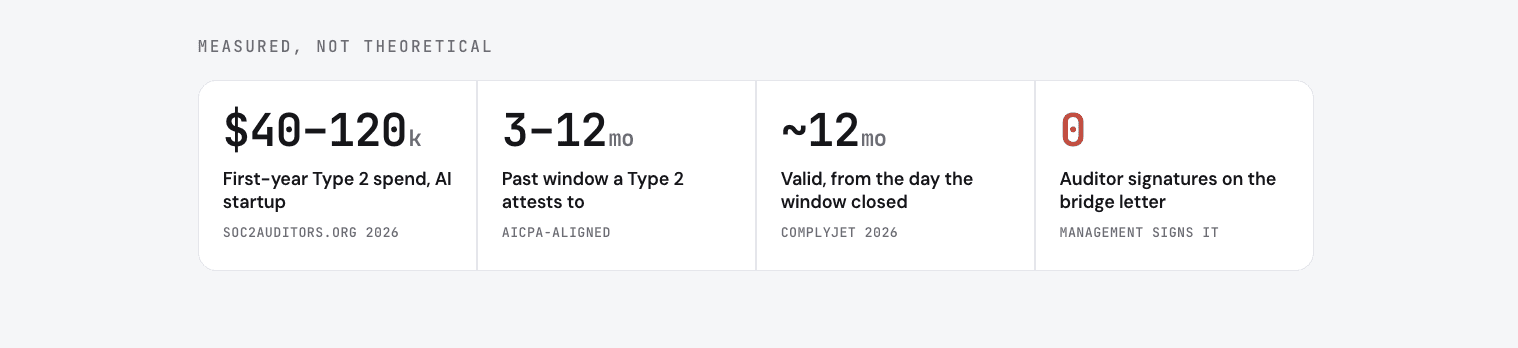
SOC 2 is still a real procurement gate. In 2026, enterprise vendor-risk teams decline to open commercial conversations without an in-date Type 2 report covering a vendor's AI controls, and first-year Type 2 spend for an AI startup runs about $40k to $120k. The report matters, and vendors pay real money for it.
What it proves is narrower than the badge suggests. A Type 2 reports on how a set of controls operated across a past window, usually three to twelve months. That window has always closed by the time the report lands on your desk, and the report is treated as valid for roughly twelve months from the day the window ended, not the day you read it.
For infrastructure that changes on a change-management cadence, that lag is fine. AI vendors ship model and prompt changes continuously, often with no notice. The system the report describes can move the week after the window closes, and the report will not know.
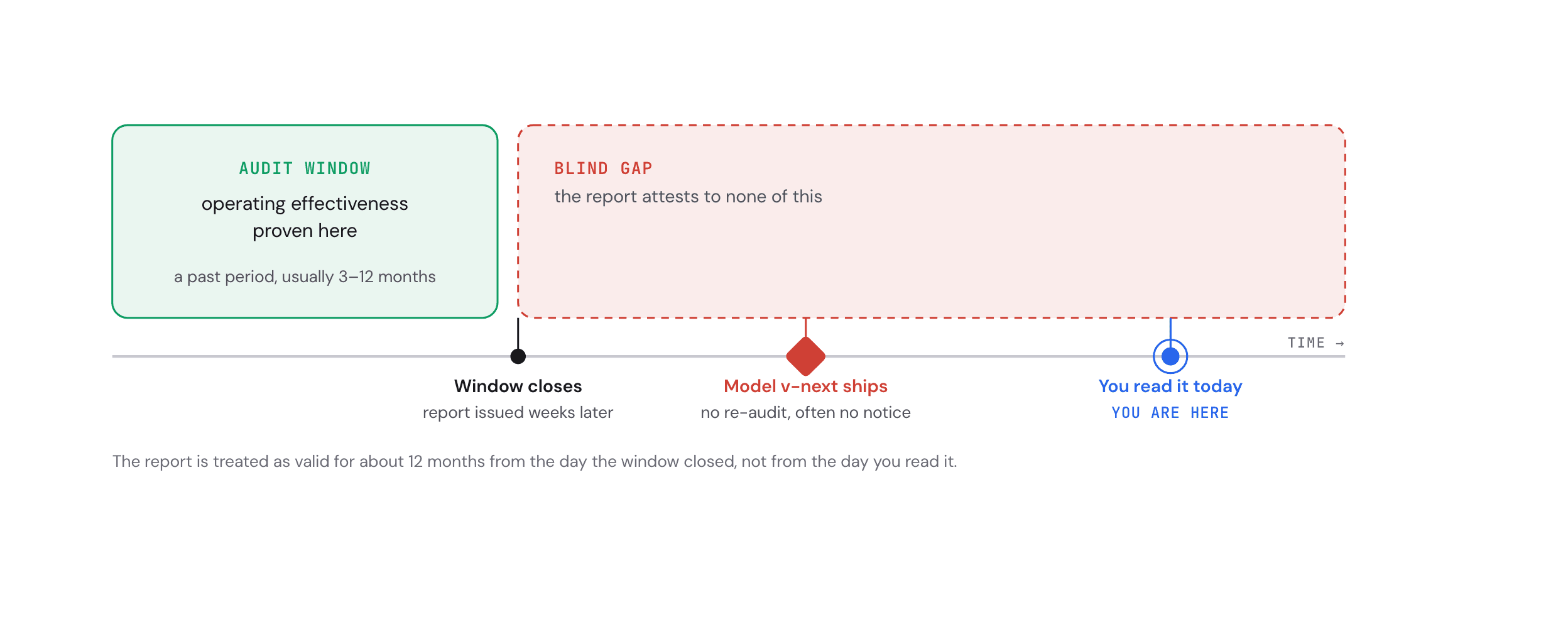
A SOC 2 describes a window that has already closed.
Two report types get mixed up, so start with the precise definitions. Both come from the AICPA, the American Institute of Certified Public Accountants.
A Type 1 report evaluates whether controls are designed appropriately at a single point in time, one date. It says nothing about whether those controls held up over the months that followed.
A Type 2 report goes further. It evaluates both the design and the operating effectiveness of controls across a defined period, the audit window. This is the report enterprise buyers ask for, because it shows the controls held up day after day, not just on paper.
Here is the part that matters for an AI vendor. The audit window is in the past. It ends, then the auditor writes the report, then you read it, sometimes months later. A Type 2 is an honest, independent account of a period that is already over. It was built for systems that change slowly and announce their changes. A foundation-model swap, a new system prompt, a fine-tune on last quarter's data, none of that follows a change-management calendar.
A report about the past gets read as a live guarantee.
None of this makes SOC 2 worthless. It goes wrong when a reader treats a report about the past as a promise about the present.
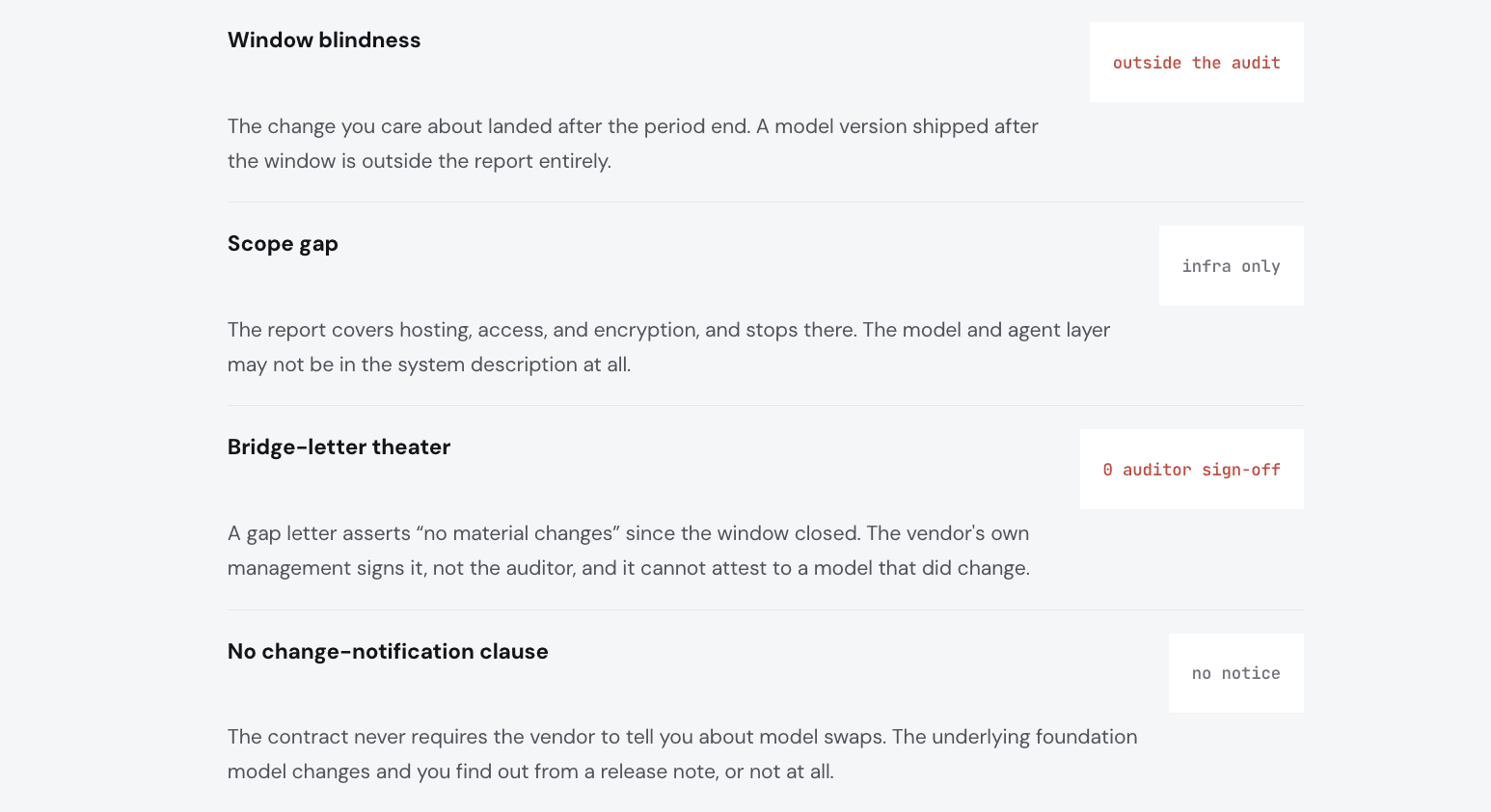
The bridge letter deserves a closer look, because it is the control most buyers lean on to cover the gap, and it carries the least weight. A bridge letter (or gap letter) is signed by the service organization's own management, typically a CISO or CFO, and states they are unaware of material changes since the report period. The CPA firm does not sign it and will not, because attesting to a period they never audited would break their independence. Most enterprise buyers cap acceptance at three months, and regulated buyers often reject it outright. It is a stopgap, and for a vendor shipping model changes it is a claim about the exact thing the letter cannot verify.
Read the window, then cover the gap.
The report stays useful. Read it for what it is, a strong signal that a vendor runs a real control program, then close the distance between the window it describes and the model you are running today.
The mainstream shift in 2026 backs this up: auditors and enterprise buyers now expect continuous monitoring rather than a single annual snapshot, because sophisticated reviewers want evidence that controls ran every day of the period, not just on the day evidence was collected.
For an AI vendor, “continuous” has to reach the model layer. A point-in-time attestation cannot show you that a vendor's prompt logging kept running across a model upgrade. Only ongoing evidence plus a contract that forces disclosure can. That is the same blind spot the AI-vendor questionnaire post flags as red flag #10, silent model auto-updates: a report window says nothing about a version shipped after it closed.
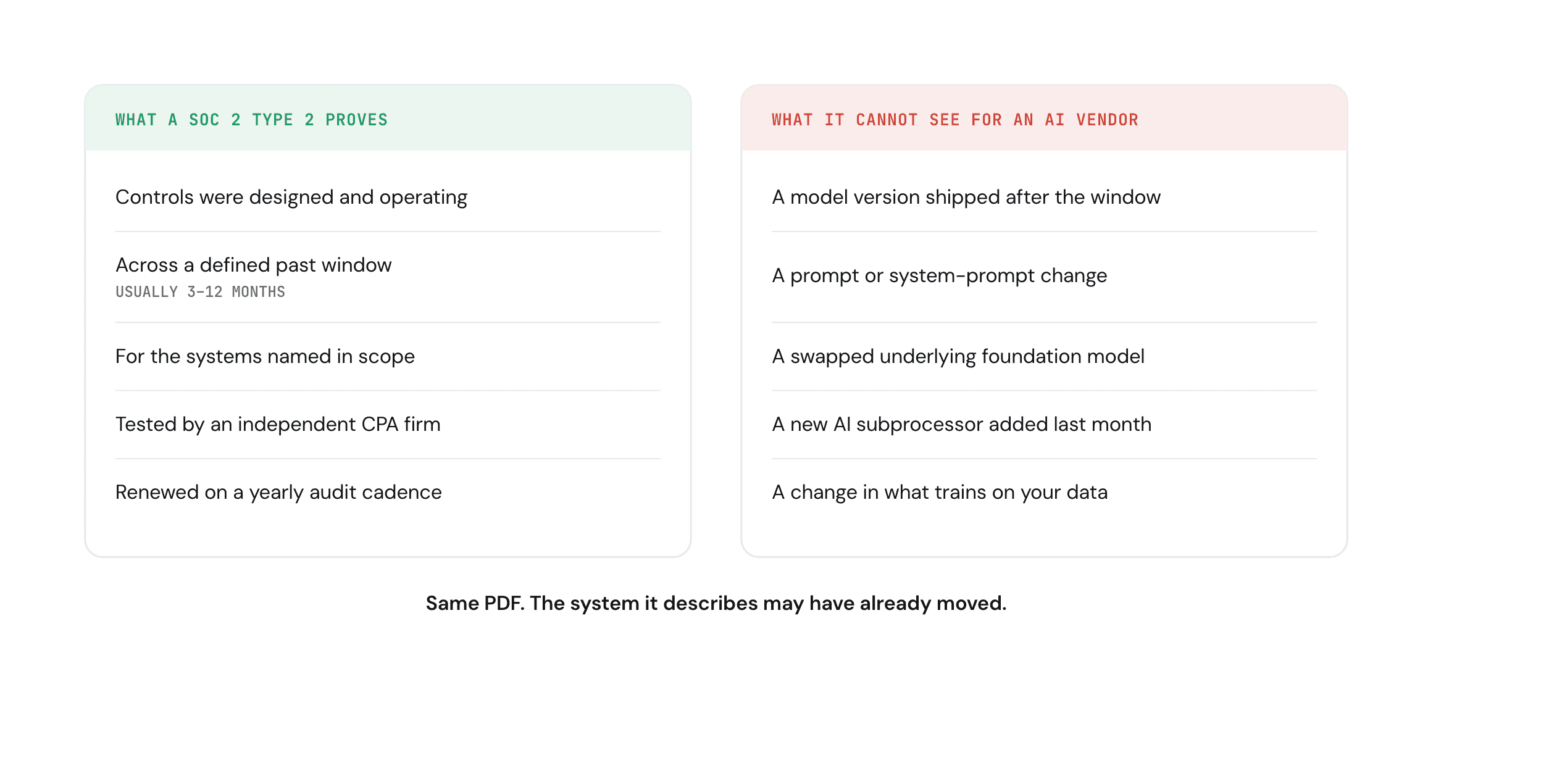
Read the report correctly, then cover the stretch it cannot reach.
You handle this from two directions. Both matter, and neither is optional for an AI vendor.
ARead the report right
When the SOC 2 lands on your desk
1Check the window, not the cover date
Find the period start and end in the report, and count validity from the end date. A glossy cover with a stale window is a stale report.
Closes window blindness
2Check that the model layer is in scope
Read the system description. If it covers hosting and access but never names the model, prompts, or agent actions, the AI risk was never assessed.
Closes scope gap
3Scrutinize the bridge letter
See who signed it and what it claims. Management asserting “no material changes” while the model shipped a new version is the claim to distrust most.
Closes bridge-letter theater
4Trace subservice orgs and AI subprocessors
Check which providers are carved in or out, and ask for the current AI subprocessor list. A model provider added after the window is invisible in the report.
Closes hidden supply
BCover the gap SOC 2 leaves
Between reports, where the model keeps changing
1Require contractual model-change notice
Put a clause in the agreement: the vendor tells you before a foundation-model swap, a material prompt change, or a training-data change. No notice, no silent change.
Closes silent updates
2Monitor continuously, not annually
Track the vendor's posture between reports rather than waiting for next year's refresh. The annual cadence is the floor, not the coverage.
Closes window blindness
3Set re-test triggers
Tie a fresh review to events, a new model version or a new subprocessor, not to the calendar alone. The change should pull the assessment, not the date.
Closes model drift
4Put freshness SLAs on evidence
Define how old a control artifact can be before it stops counting, and hold the vendor to it. Assurance has a shelf life; write it down.
Closes stale assurance
A SOC 2 tells you a vendor was secure last year. Your AI vendor changed its model last week.
SOC 2 does exactly what it was built to do: an independent, rigorous account of how a vendor's controls operated over a period that is now behind you. For an AI vendor that changes its model between reports, that account can be genuine and current on paper while the system it describes has already moved. The report is the floor. The work is covering the distance to the model you are running today.
See how Zania runs third-party risk autonomously →
Sources
01SOC 2 for AI Companies (procurement gate, first-year Type 2 spend), soc2auditors.org
02SOC 2 Type 1 vs Type 2 (design vs operating effectiveness, 3–12 month window), Secureframe
03SOC 2 Report Validity and the 12-month rule, ComplyJet
04SOC 2 in 2026: Why Point-in-Time Audits Are Dead, LowerPlane
05SOC 2 Continuous Monitoring: Best Practices for 2026, Konfirmity
06SOC 2 Type 2 for AI Companies 2026 (model versioning, drift), Knowlee
07SOC 2 Bridge Letter, signed by management not the CPA firm, IS Partners
08Your security questionnaire has an AI section, red flag #10 (silent auto-updates), Zania Research
Share
