
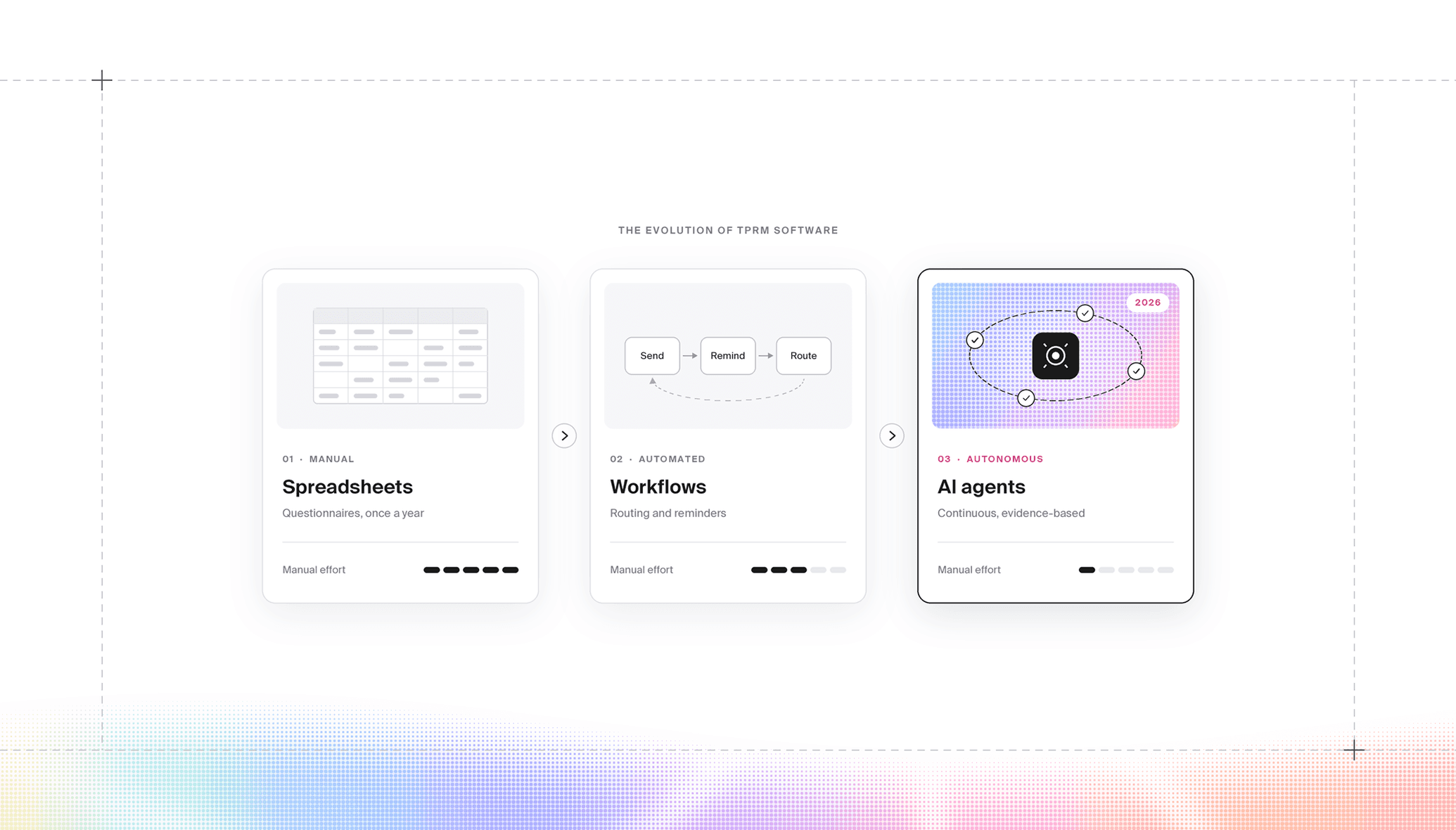
Third-party risk management (TPRM) is no longer a static, point-in-time exercise. As enterprise vendor ecosystems expand to include hundreds of cloud services, SaaS platforms, and AI tools, the traditional approach of annual spreadsheets and manual questionnaires has become fundamentally unscalable. Modern organizations require third-party risk management software that provides continuous, evidence-based oversight without overwhelming security teams or inducing vendor fatigue. This guide explores the current state of TPRM software, the critical features required for modern risk management, and how autonomous AI agents are fundamentally changing how enterprises evaluate and monitor their vendors.
The Problem with Traditional TPRM
The primary challenge facing security and compliance teams today is volume. As organizations adopt specialized tools across every department, the attack surface expands exponentially. You are no longer managing just direct vendors; you are exposed to their sub-processors, infrastructure providers, and downstream dependencies. Traditional third-party risk management software often relies on a questionnaire-first approach. This methodology presents several critical flaws: (1) Point-in-time visibility: A questionnaire only reflects a vendor’s security posture on the day it was submitted. It cannot detect configuration drift or new vulnerabilities that emerge weeks or months later. (2) Vendor fatigue: Security teams at vendor organizations are overwhelmed by repetitive, manual security questionnaires, leading to delayed responses and friction in the procurement process. (3) Inability to scale: Manual review processes require significant human capital. As the vendor ecosystem grows, compliance teams cannot scale linearly to meet the demand.
Essential Features of Modern Third-Party Risk Management Software
When evaluating TPRM platforms in 2026, organizations must look beyond basic workflow automation. The most effective solutions provide comprehensive visibility and actionable intelligence.
Continuous Risk Monitoring:
Annual reviews create unacceptable blind spots. Modern TPRM software must surface meaningful changes as they happen, supporting portfolio-level monitoring at scale. This includes tracking external attack surface exposure, monitoring for new vulnerabilities, and detecting changes in a vendor’s compliance status.
Non-Intrusive Vendor Assessments:
The most advanced platforms are moving away from manual questionnaires. Instead, they enrich assessments with external intelligence, such as security ratings, breach history, and exposed assets. This approach reduces the burden on vendors while providing a more objective, evidence-based view of risk.
Automated Compliance Mapping:
Enterprise compliance programs must navigate multiple frameworks simultaneously, including SOC 2, ISO 27001, NIST, HIPAA, and GDPR. TPRM software should automatically map vendor controls to these frameworks, reducing duplicate effort and generating audit-ready evidence on demand.
The Rise of Autonomous TPRM
The most significant evolution in third-party risk management software is the shift from automated workflows to autonomous AI agents. While traditional automation helps route tasks and send reminders, autonomous TPRM fundamentally changes how work is performed. Zania’s approach to TPRM utilizes AI compliance agents that perform controls testing, risk assessments, and audits with provable accuracy. This agentic model offers several distinct advantages: Elimination of Questionnaires: AI agents can analyze a vendor’s trust center, security documentation, and compliance reports to autonomously answer assessment questions, removing the manual burden from both sides. Continuous Evidence Collection: Rather than relying on periodic snapshots, autonomous agents continuously collect and verify evidence, ensuring that risk assessments reflect the current state of a vendor’s environment. Scalable Coverage: A single compliance team can maintain active oversight of hundreds of vendors simultaneously, something that is operationally impossible with manual processes.
How to Evaluate TPRM Software in 2026
When selecting a third-party risk management platform, procurement and security teams should evaluate vendors across several dimensions. First, assess the depth of automation: does the platform merely automate questionnaire distribution, or does it perform autonomous evidence collection and controls testing? Second, examine the accuracy model: how does the platform ensure that AI-generated assessments are accurate and auditable? Zania, for example, publishes its accuracy benchmarks and provides full citation trails for every finding. Third, consider the integration ecosystem: modern TPRM software must connect with existing GRC platforms, ticketing systems, and procurement workflows to avoid creating yet another siloed tool. Finally, evaluate the vendor’s approach to continuous monitoring versus point-in-time assessments.
Conclusion:
The third-party risk management software landscape is undergoing a fundamental transformation. The platforms that will define the next generation of TPRM are those that move beyond workflow automation to deliver autonomous, evidence-based risk intelligence at scale. For organizations looking to scale their vendor risk programs without scaling headcount, autonomous AI agents represent the most significant operational leverage available today. To see how Zania’s AI agents approach third-party risk management, request a demo. For a full feature comparison and buyer’s guide, visit our dedicated third-party risk management software page.
Share

© 2026 Zania Inc.
1950 University Ave Palo Alto, CA 94303