
SOC 2 automation is now roughly a $1.3B market, up 53% from $850M in 2025. On paper, that looks like a category riding a new wave of regulation. It isn't. The AICPA hasn't materially changed SOC 2's Trust Services Criteria since 2022 — there is no new rule behind this year's growth. What's actually driving it is buyer pressure and breach fallout, and 2026 has supplied plenty of both.

The 60-second version
ISC2's 2025 Supply Chain Risk Survey found 77% of organizations now cite standards like SOC 2, ISO 27001, or NIST as their top requirement when evaluating a vendor — climbing to 84% in financial services and 87% among defense contractors. Then, in March 2026, the Delve scandal broke: a leaked spreadsheet suggested hundreds of SOC 2 reports from one compliance vendor were near-identical templates. Buyers started asking a sharper question — not "do you have the badge," but "who signed it, and can I verify that." Meanwhile, Thoropass's 2026 State of Audit and Compliance Report found 69% of security professionals say AI adoption is outpacing their controls, and 55% now rank AI-related data exposure above ransomware as their top breach concern.
Put those together and the market's growth stops looking like healthy demand and starts looking like buyers trying to compensate for a badge that stopped meaning what they thought it meant.
Growth without a new rule is buyers doing their own diligence.
When a market grows 53% without a regulatory trigger, the growth is coming from somewhere else: existing buyers deciding the old bar isn't high enough. That's consistent with what's happening industry-wide. Enterprise procurement teams that once treated a SOC 2 logo as a checkbox are increasingly asking to see the auditor's name, the observation period, and the underlying evidence — not just the summary opinion.
The category's leaders automate the evidence. Not the verification.
Vanta, Drata, and Anecdotes are three of the most widely adopted platforms in this space, and independent 2026 comparisons describe them consistently: strong at automating evidence collection, continuous monitoring, and framework mapping across SOC 2, ISO 27001, HIPAA, and GDPR. That's real, valuable automation — it is also, by design, not the same job as verification.
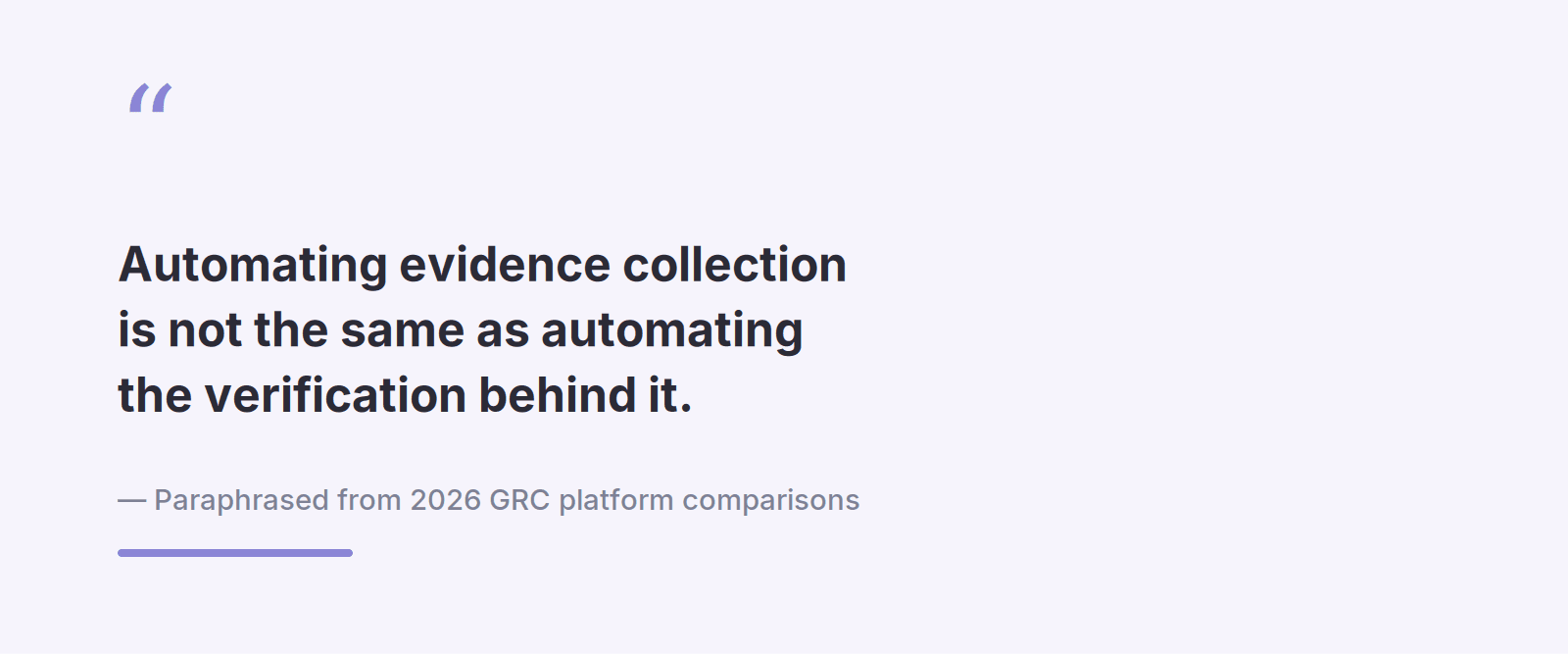
One 2026 platform comparison put it plainly: neither of the two market leaders replaces a security program outright — they automate evidence collection and monitoring, but they don't design the controls, decide what evidence actually proves, or build the policies that make a configuration meaningful. That gap is exactly where a badge can look complete and still not answer the question a buyer is actually asking: does this evidence hold up?
Verify before you automate. Two checks, run together.
A · What to check on any vendor's compliance claim today
1 Confirm accreditation independently
Check the signing CPA firm against the AICPA's own public records rather than the name on the letterhead.
Closes unverified-auditor risk
2 Ask for evidence samples, not just the dashboard
A screenshot of a green checkmark is not the same as the artifact behind it.
Closes unverifiable-claim risk
3 Ask whether the platform tests controls or polls integrations
Continuous monitoring and continuous control testing are not the same claim.
Closes monitoring-vs-testing confusion
4 Ask what happens after a control fails
A red flag with no remediation path is a to-do list, not a fix.
Closes unclosed-finding risk
B · What next-generation GRC needs to actually do
1 Attach visible reasoning to every conclusion
A pass or fail should come with the "why," not just the result.
Closes black-box-verdict risk
2 Tie every claim to a cited source
Confidence scores mean little without the evidence they're scored against.
Closes unverifiable-claim risk
3 Execute remediation, not just flag it
Finding a gap and closing it are different products; buyers increasingly want both.
Closes unclosed-finding risk
4 Re-test automatically once a fix ships
Don't wait for next year's audit cycle to confirm the fix actually worked.
Closes stale-verification risk
The badge was always a proxy. 2026 is the year buyers started checking what it stood for.
A $1.3B market growing on buyer skepticism, not new regulation, is a market correcting itself. The vendors that win the next phase won't be the ones with the biggest integration library — they'll be the ones whose conclusions a buyer can actually check.
See how Zania builds explainable, source-cited compliance work →
Sources
SOC 2 Compliance Market Size 2026: What the Data Actually Shows, ComplyJet
SOC 2 News (Updated May 2026), ComplyJet — Thoropass 2026 State of Audit and Compliance Report
Vanta vs Drata (2026): Full Comparison + a Third Option, Strac
Top 10 Compliance Automation Platforms of 2026, Deepak Gupta
The Delve Scandal: When Your SOC 2 Report Is Just a Template, ComplianceHub.Wiki
Share
