
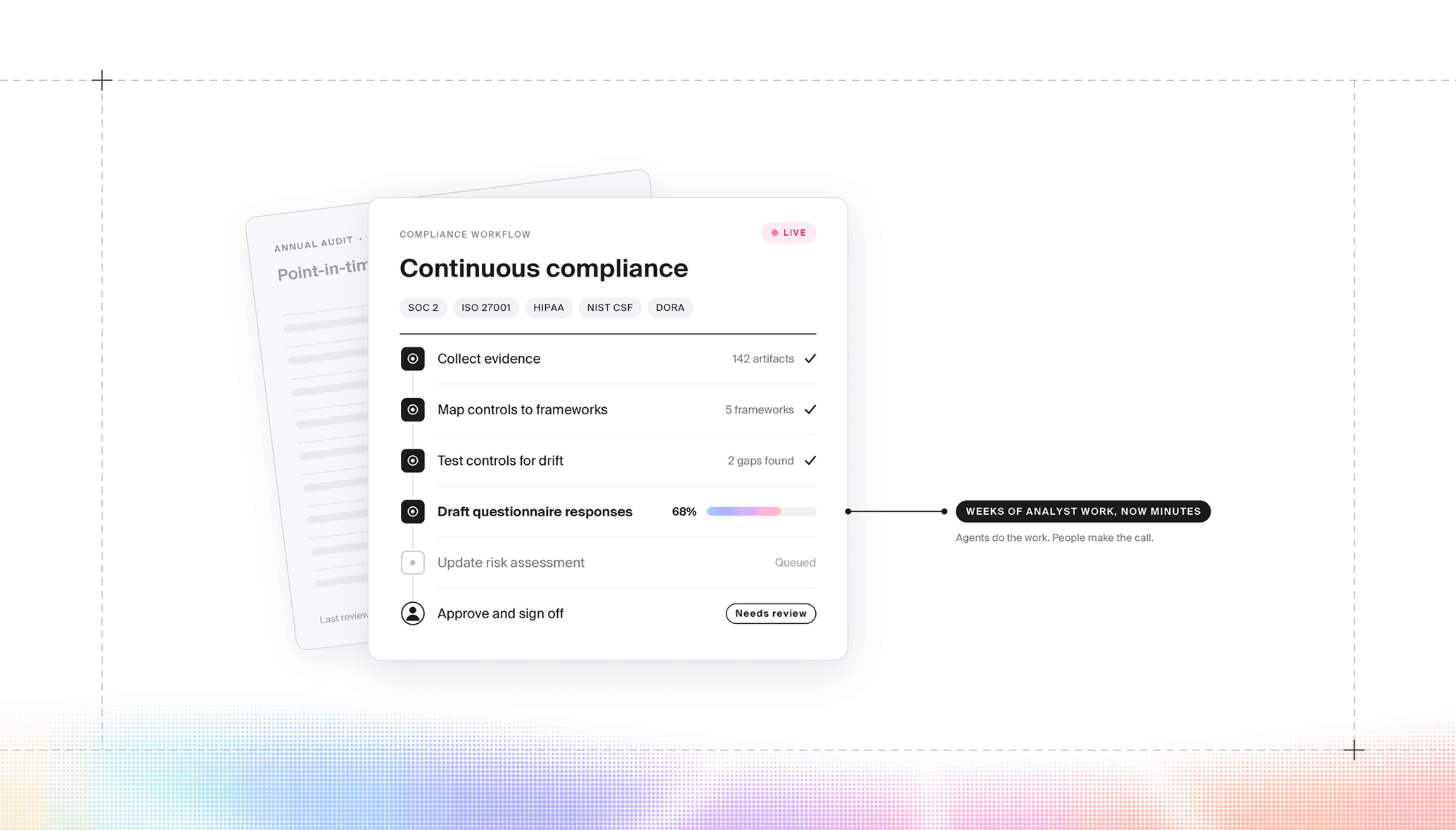
Ask anyone who has run enterprise compliance and they'll describe the same yearly ritual. Months of scrambling ahead of the audit. Screenshots, spreadsheets, and evidence dug out of a dozen systems. A frantic push to close every gap, then the collective exhale when the report finally comes back clean.
Then do it all again next year.
Here's the uncomfortable part: that whole approach has quietly stopped working. Treating compliance as a once-a-year event doesn't just waste effort in 2026, it leaves real exposure on the table between audits.
Why the Old Compliance Playbook No Longer Works
The threat environment doesn't pause between audits. Neither do regulators.
The EU AI Act's high-risk system obligations are fast approaching, and despite a likely deadline extension under the Digital Omnibus agreement, compliance programs at most enterprises are still in early stages. The SEC has elevated cybersecurity and AI governance to its top risk priorities. NIST CSF 2.0 introduced a formal "Govern" function, putting direct accountability on boards and executives. And overlapping frameworks (DORA, NIS2, CMMC, SOC 2, ISO 27001) have created a compliance complexity that no spreadsheet or annual review cycle can keep up with.
The problem isn't just volume. It's that point-in-time audits create a false sense of security. A clean audit report from six months ago tells you nothing about what's happening in your environment right now.
CISOs know this. And increasingly, they're demanding something better.
The Shift: From Compliance as Documentation to Compliance as a Live System
The most forward-thinking security leaders aren't treating compliance as a documentation exercise. They're treating it as an operational capability: one that runs continuously, generates evidence automatically, and surfaces risk in real time.
This is the core shift happening across enterprise GRC right now: from periodic, manual compliance workflows to always-on, AI-driven compliance infrastructure.
What does that look like in practice?
Automated evidence collection pulled directly from connected systems such as identity providers, cloud environments, endpoint management rather than manually assembled before each audit
Continuous control testing that flags drift the moment it happens, not six months later
Risk assessments that update in real time as your vendor landscape, team, and tech stack change
Audit-ready documentation that exists as a byproduct of normal operations, not a sprint before a deadline
This isn't a future state. It's what leading enterprises are building today.
Where AI Agents Change Everything
Traditional GRC platforms helped organize compliance work. AI agents actually do it.
The distinction matters. Most compliance platforms are workflow managers; they tell teams what needs to happen and track whether it did. AI agents can complete the tasks themselves: pulling evidence, mapping controls to frameworks, flagging gaps, drafting responses to security questionnaires, and synthesizing risk posture across dozens of overlapping regulations.
For enterprise security teams, this means the work that used to consume weeks of analyst time like cross-mapping a vendor's SOC 2 report against your internal controls, or preparing a board-level risk summary across five frameworks can happen in minutes.
The impact is largest where compliance complexity is highest. Organizations managing SOC 2, ISO 27001, HIPAA, and new AI-specific requirements simultaneously can use AI agents to maintain a single, unified view of their compliance posture without running parallel programs that don't talk to each other. This is the end of what analysts have called "framework sprawl."
What This Means for the CISO Role
The CISO role is evolving faster than any other executive function. Three years ago, AI governance was a Legal and Compliance conversation. Today it lands on the CISO's desk because the risks AI introduces are fundamentally security problems.
That shift is creating a new set of expectations. CISOs are now accountable not just for protecting the perimeter, but for governing an expanding AI footprint, communicating risk to boards in business terms, and maintaining compliance posture across a regulatory landscape that's being rewritten in real time.
The CISOs winning in this environment share a few traits. They've stopped treating compliance as a documentation exercise and started treating it as a technical enforcement program. They've embraced automation not as a way to cut corners, but as the only way to maintain the visibility that modern risk management requires. And they've recognized that the administrative burden of compliance (the evidence collection, the questionnaire responses, the control mapping) is exactly where AI delivers the most leverage, freeing their teams to focus on actual risk reduction.
The Convergence Point: GRC Automation at Enterprise Scale
Zania was built for this moment.
We automate the most time-intensive work in enterprise GRC: security questionnaire responses, risk assessments, vendor due diligence, and compliance documentation across frameworks including SOC 2, ISO 27001, HIPAA, NIST CSF, and more. Our AI agents work the way your analysts do, but at a speed and scale that isn't humanly possible manually.
For security teams at organizations like Plaid, Netflix, KPMG, and Grant Thornton, that means compliance workflows that used to take weeks now take hours without sacrificing accuracy or auditability.
The annual audit sprint isn't going away entirely. But for enterprises that invest in continuous, AI-driven compliance infrastructure now, it becomes just one moment in an ongoing process, not a recurring crisis.
The Bottom Line:
The compliance workflows that served enterprises in 2015 aren't equipped for the regulatory environment of 2026. The organizations building resilience right now are the ones replacing manual, periodic processes with automated, continuous ones using AI agents to handle the evidence collection, control mapping, and documentation that has historically consumed security teams.
The question for CISOs isn't whether to make this shift. It's how fast.
Share

© 2026 Zania Inc.
1950 University Ave Palo Alto, CA 94303